【 MM 】聊聊 OOM 选目标原则
这一篇的主旨是 OOM 选目标的原则,也就是我们只关注发生 OOM 之后的事情发展,包括是否应该继续 OOM 选一个任务 kill 掉释放空间,以及具体应该选择哪一个任务来 kill,选择的依据是什么。
我们暂不关心为何会发生 OOM,因为这一块属于内存申请或内存回收的范畴中,我们会在其它文章中单独聊。
一、原理分析
那我们现在就直接从触发 OOM 的入口开始看起,通常 OOM 的发生是因为在内存紧张时,在采取了一些回收、规整手段后仍无法缓解,得不到想要的内存页,不得以才触发的。所以它的入口藏在内存申请的流程中,它就是 __alloc_pages_may_oom,
static inline struct page *
__alloc_pages_may_oom(gfp_t gfp_mask, unsigned int order,
	const struct alloc_context *ac, unsigned long *did_some_progress)
{
	struct oom_control oc = {
		.zonelist = ac->zonelist,
		.nodemask = ac->nodemask,
		.memcg = NULL,
		.gfp_mask = gfp_mask,
		.order = order,
	};
	struct page *page;

	*did_some_progress = 0;												( 1 )

	if (!mutex_trylock(&oom_lock)) {									( 2 )
		*did_some_progress = 1;
		schedule_timeout_uninterruptible(1);
		return NULL;
	}

	page = get_page_from_freelist((gfp_mask | __GFP_HARDWALL) &			( 3 )
				      ~__GFP_DIRECT_RECLAIM, order,
				      ALLOC_WMARK_HIGH|ALLOC_CPUSET, ac);
	if (page)
		goto out;

	/* Coredumps can quickly deplete all memory reserves */
	if (current->flags & PF_DUMPCORE)									( 4 )
		goto out;
	/* The OOM killer will not help higher order allocs */
	if (order > PAGE_ALLOC_COSTLY_ORDER)								( 5 )
		goto out;

	if (gfp_mask & (__GFP_RETRY_MAYFAIL | __GFP_THISNODE))
		goto out;
	/* The OOM killer does not needlessly kill tasks for lowmem */
	if (ac->highest_zoneidx < ZONE_NORMAL)
		goto out;
	if (pm_suspended_storage())
		goto out;

	/* Exhausted what can be done so it's blame time */
	if (out_of_memory(&oc) || WARN_ON_ONCE(gfp_mask & __GFP_NOFAIL)) {	( 6 )
		*did_some_progress = 1;

		/*
		 * Help non-failing allocations by giving them access to memory
		 * reserves
		 */
		if (gfp_mask & __GFP_NOFAIL)
			page = __alloc_pages_cpuset_fallback(gfp_mask, order,
					ALLOC_NO_WATERMARKS, ac);
	}
out:
	mutex_unlock(&oom_lock);
	return page;
}
1)我对这个标识的理解是,在内存紧张的情况发生后是否已经做过了什么举措来缓解这一囧境,例如直接回收、OOM 等,如果有做过那就置为 1;
2)这个锁只有在 OOM 上下文涉及,如果获取失败则说明有其它任务正在做 OOM,所以在这里退出即可;
3)
4)如果当前任务发生了 coredump,那么也不再继续 OOM,后续 coredump 也会释放全部内存;
5)符合以下几种条件的,OOM 也会立刻终止,
① order 相对较高的时;
②
③
④
6)在这里调用到 out_of_memory 继续流程;
那我们接着来看,
bool out_of_memory(struct oom_control *oc)
{
	unsigned long freed = 0;

	if (oom_killer_disabled)											( 1 )
		return false;

	if (!is_memcg_oom(oc)) {
		blocking_notifier_call_chain(&oom_notify_list, 0, &freed);
		if (freed > 0)
			/* Got some memory back in the last second. */
			return true;
	}

	/*
	 * If current has a pending SIGKILL or is exiting, then automatically
	 * select it.  The goal is to allow it to allocate so that it may
	 * quickly exit and free its memory.
	 */
	if (task_will_free_mem(current)) {									( 2 )
		mark_oom_victim(current);
		wake_oom_reaper(current);
		return true;
	}

	/*
	 * The OOM killer does not compensate for IO-less reclaim.
	 * pagefault_out_of_memory lost its gfp context so we have to
	 * make sure exclude 0 mask - all other users should have at least
	 * ___GFP_DIRECT_RECLAIM to get here. But mem_cgroup_oom() has to
	 * invoke the OOM killer even if it is a GFP_NOFS allocation.
	 */
	if (oc->gfp_mask && !(oc->gfp_mask & __GFP_FS)
            && !is_memcg_oom(oc))										( 3 )
		return true;

	/*
	 * Check if there were limitations on the allocation (only relevant for
	 * NUMA and memcg) that may require different handling.
	 */
	oc->constraint = constrained_alloc(oc);								( 4 )
	if (oc->constraint != CONSTRAINT_MEMORY_POLICY)
		oc->nodemask = NULL;
	check_panic_on_oom(oc);

	if (!is_memcg_oom(oc) && sysctl_oom_kill_allocating_task &&			( 5 )
	    current->mm && !oom_unkillable_task(current) &&
	    oom_cpuset_eligible(current, oc) &&
	    current->signal->oom_score_adj != OOM_SCORE_ADJ_MIN) {
		get_task_struct(current);
		oc->chosen = current;
		oom_kill_process(oc, "Out of memory (oom_kill_allocating_task)");
		return true;
	}

	select_bad_process(oc);												( 6 )
	/* Found nothing?!?! */
	if (!oc->chosen) {
		dump_header(oc, NULL);
		pr_warn("Out of memory and no killable processes...\n");
		/*
		 * If we got here due to an actual allocation at the
		 * system level, we cannot survive this and will enter
		 * an endless loop in the allocator. Bail out now.
		 */
		if (!is_sysrq_oom(oc) && !is_memcg_oom(oc))
			panic("System is deadlocked on memory\n");
	}
	if (oc->chosen && oc->chosen != (void *)-1UL)
		oom_kill_process(oc, !is_memcg_oom(oc) ? "Out of memory" :		( 7 )
				 "Memory cgroup out of memory");
	return !!oc->chosen;
}
1)一般只有在设备即将进去休眠时才会将 OOM KILLER 关掉;
2)
3)
4)
5)
6)正式进入猎杀时刻,会在后续流程中评估出一个最佳的对象来 kill;
7)
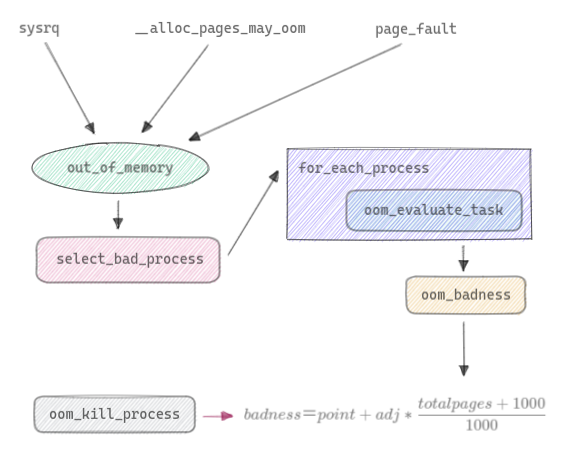
如果流程已经走到 select_bad_process,那便说明系统已经决定要找一个任务来祭天了,关于是这个任务是如何被评估选中的,我们继续来看,
在不考虑 memcg oom 的情况下,它会依次遍历所有的 process,对其调用 oom_evaluate_task 进行评估,
static int oom_evaluate_task(struct task_struct *task, void *arg)
{
	struct oom_control *oc = arg;
	long points;

	if (oom_unkillable_task(task))										( 1 )
		goto next;

	/* p may not have freeable memory in nodemask */
	if (!is_memcg_oom(oc) && !oom_cpuset_eligible(task, oc))			( 2 )
		goto next;

	if (!is_sysrq_oom(oc) && tsk_is_oom_victim(task)) {					( 3 )
		if (test_bit(MMF_OOM_SKIP, &task->signal->oom_mm->flags))
			goto next;
		goto abort;
	}

	if (oom_task_origin(task)) {										( 4 )
		points = LONG_MAX;
		goto select;
	}

	points = oom_badness(task, oc->totalpages);							( 5 )
	if (points == LONG_MIN || points < oc->chosen_points)
		goto next;

select:
	if (oc->chosen)
		put_task_struct(oc->chosen);
	get_task_struct(task);
	oc->chosen = task;													( 6 )
	oc->chosen_points = points;
next:
	return 0;
abort:
	if (oc->chosen)
		put_task_struct(oc->chosen);
	oc->chosen = (void *)-1UL;
	return 1;
}
1)判断所选中的任务是否允许被 kill,如果该任务是 init 1 号进程或为内核线程的话,则返回 true 代表不能被选中;
2)
3)
4)在这里可以判断下当前任务是否申请过大量的内存,有的话直接选中,内核中有各别功能,例如 swapoff 系统调用会在其中通过 set_current_oom_origin 标记当前任务有大量内存申请;
5)评估当前任务的 point,分数越高越容易被选中,具体计算方法下面分析;
6)更新 oc->chosen,它作为被选中对象信息记录的载体;
现在来看一下 point 的值到底是怎样计算出来的,
long oom_badness(struct task_struct *p, unsigned long totalpages)
{
	long points;
	long adj;

	if (oom_unkillable_task(p))											( 1 )
		return LONG_MIN;

	p = find_lock_task_mm(p);											( 2 )
	if (!p)
		return LONG_MIN;

	adj = (long)p->signal->oom_score_adj;
	if (adj == OOM_SCORE_ADJ_MIN ||
			test_bit(MMF_OOM_SKIP, &p->mm->flags) ||
			in_vfork(p)) {												( 3 )
		task_unlock(p);
		return LONG_MIN;
	}

	/*
	 * The baseline for the badness score is the proportion of RAM that each
	 * task's rss, pagetable and swap space use.
	 */
	points = get_mm_rss(p->mm) + get_mm_counter(p->mm, MM_SWAPENTS) +
		mm_pgtables_bytes(p->mm) / PAGE_SIZE;							( 4 )
	task_unlock(p);

	/*
	 * Normalize to oom_score_adj units.  You should never
	 * multiply by zero here, or oom_score_adj will not work.
	 */
	adj *= (totalpages + 1000) / 1000;
	points += adj;														( 5 )

	return points;
}
1)上面已提及;
2)TODO
3)取出该任务对应的 oom_score_adj 值,它可以用户态接口进行指定,范围是 [-1000, 1000],
4)统计该任务所占用的内存页面数并转存到 point;
5)计算该任务对应的 badness,涉及到的计算公式如下,

分数最高者那么将做为 OOM 的最佳对象。
用一张图示总结一下上述的全部过程,当然 OOM 不仅仅只会在内存申请的过程中会触发到,也在 sysrq、page_fault 中有涉及,